

Ho’oponopono Reimagined
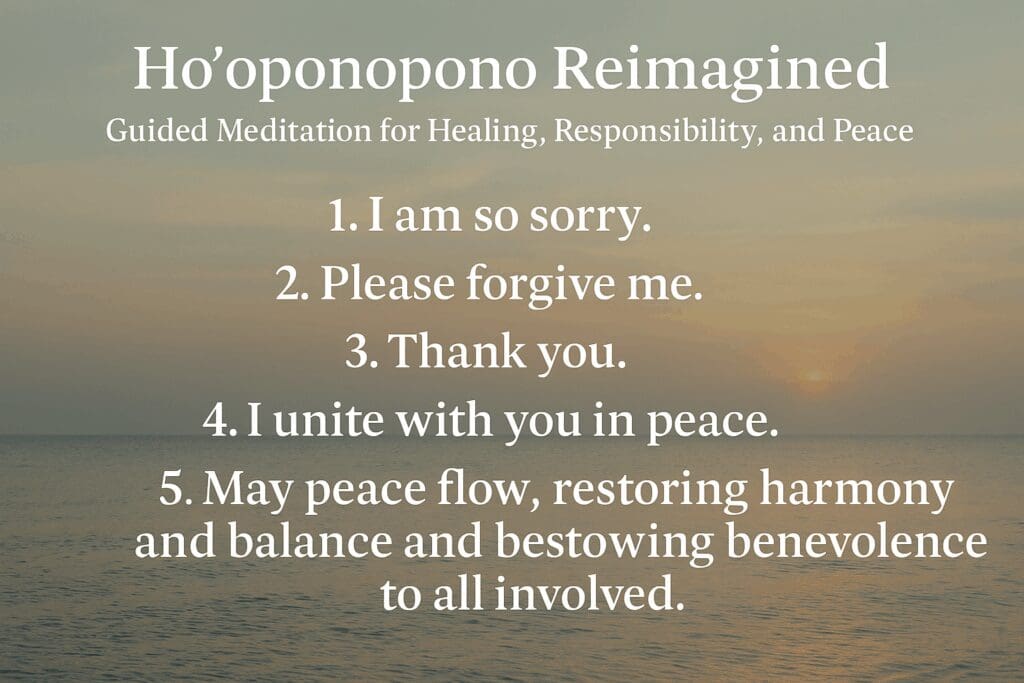
Ho‘oponopono Reimagined:
A Valor Healing Practices Workbook
In every culture, there are ancient tools that help us mend, restore, and return to balance. In Hawai‘i, one of the most profound is Ho‘oponopono—a practice traditionally used to heal relationships, restore right action (pono), and cleanse the shared field between people.
Ho‘oponopono is often summarized today in four phrases, but its deeper purpose is far richer:
to clear energetic debris, release stored tension, and restore harmony between people, within families, and within the self.
At Valor Institute and within our LifeForce programs, we take a relational-health approach to this work. Healing is not just an individual journey; it is a shared ecosystem of emotions, patterns, and learned responses. That’s why we’ve expanded the traditional phrases into a five-part practice that aligns with trauma-informed care, emotional literacy, and the Hawaiian intention of restoring balance.
This reimagined version honors the roots of Ho‘oponopono while offering language that is clear, boundaried, accessible, and psychologically supportive for modern relationships.
Why Ho‘oponopono Matters Today
In stressful or fractured relationships, people often carry:
- unspoken expectations
- past hurts
- misinterpretations
- emotional echoes from previous relationships
- guilt, shame, or regret
- ancestral or family patterns
- the need to be “right” instead of at peace
Ho‘oponopono gives us a structured path to dissolve these knots. It allows us to step out of defensiveness and into maturity, humility, and clarity. It acknowledges that healing flows through the shared relational field—not just through one person trying harder.
As your workbook notes:
“Healing occurs through connection, not mechanics.”
The Reimagined Five-Part Practice
1. I am so sorry.
Acknowledge the part of you that contributed to the moment—without guilt or self-blame.
This step is about responsibility, not fault.
It means:
- “I see how my actions, reactions, or unhealed parts may have played a role.”
- “I choose presence over defensiveness.”
- “I prefer peace over being right.”
This step dissolves the urge to justify or defend—opening the door to clarity and healing.
2. Please forgive me.
The humility of asking, not offering.
This part is rarely discussed: asking for forgiveness is much harder than giving it.
It invites:
- grace
- humility
- a softening of ego
- a shift toward equality and compassion
As your workbook explains:
“Granting forgiveness often feels easier because it is based in ego…
But asking humbles us and makes healing mutual.”
Forgiveness may come from the other person, from the universe, or simply from the restored space within you.
3. Thank you.
Gratitude for the growth, the clarity, and the deeper understanding.
Here, gratitude isn’t for the pain itself—it’s for what the experience taught you:
- the boundaries it revealed
- the resilience it awakened
- the truth it surfaced
- the lessons it offered
- the personal growth it allowed
You shift from wounded to wiser, from reactive to grounded.
4. I wish you well.
Recognizing shared humanity and restoring energetic harmony.
In traditional Hawaiian thought, “love” (aloha) means unity, balance, and goodwill—not romance.
To avoid confusion, this updated phrasing reflects the Hawaiian essence while remaining emotionally clean and clear.
It means:
- “We share a field of life-force.”
- “Your dignity matters.”
- “I choose connection over separation.”
- “I honor the humanity in both of us.”
It does not imply closeness, reconciliation, or agreement.
It simply restores balance at the human level.
5. May peace flow.
May peace flow, restoring harmony and balance and bestowing benevolence to all involved. The essential final step: filling the cleared space with intention.
Once conflict or emotional debris is cleared, the space must be filled with something new.
This final intention invites:
- harmony
- clarity
- benevolence
- right balance (pono)
- peaceful forward motion
It not only heals the past—it shapes the future.
As your workbook notes:
“This makes the practice not just reparative, but generative.”
The Full Practice (One Flow)
- I am so sorry.
- Please forgive me.
- Thank you.
- I wish you well.
- May peace flow.
You can speak these inwardly, whisper them aloud, or write them in your journal.
How to Use Ho‘oponopono in Daily Life
1. The Breath-Cleanse Ritual
Inhale: I am so sorry.
Hold: Please forgive me.
Exhale: Thank you.
Rest: I wish you well.
Intend: May peace flow.
Repeat slowly three times. One hand over the heart.
2. The Memory Stone Ritual
Hold a small stone.
Name the hurt or tension.
Speak the five phrases.
Place the stone in water or soil.
Imagine the energy dissolving.
3. Relationship Repair (Private Practice)
Picture the energetic pathway between you and someone else.
Clear the debris with the five phrases.
No other person is needed.
This is especially powerful for family, caregiving, and long-held emotional patterns.
4. Clearing Before Sleep
Say the phrases once inwardly.
Imagine the day dissolving.
Let peace settle into the space.
Begin again tomorrow.
Why This Practice Works
This five-part framework is:
- trauma-informed
- emotionally safe
- spiritually grounded
- culturally respectful
- psychologically insightful
- relationally realistic
It does not require reconciliation, contact, or resolution.
It simply clears what needs clearing—and restores dignity, balance, and peace.
As your workbook concludes:
“It allows healing without false intimacy, closure without denial, and renewal without bypassing any part of the truth.”
Final Reflection
Healing is not about changing the past.
It is about shifting the energy that lives inside us now.
When we say:
May peace flow, restoring harmony and benevolence…”
we choose a future that is lighter, clearer, and more whole.
Ho‘oponopono reminds us that we are always capable of returning to balance—one breath, one moment, one intention at a time.