

Uplifting the Human Spirit
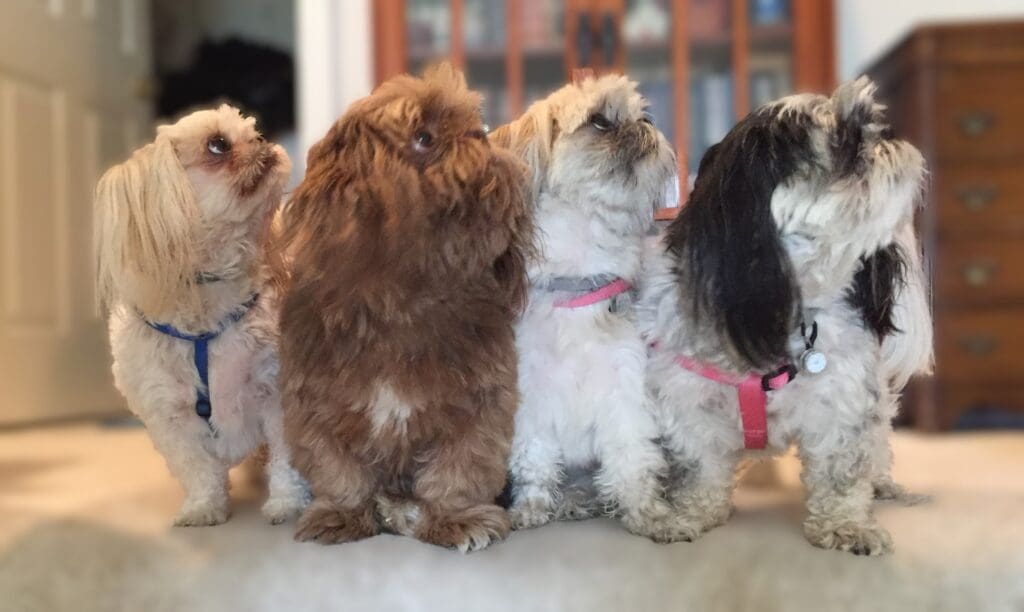
Uplifting the Human Spirit
What our animals teach us—and what we might hear if we learned to listen differently.
Dogs have been part of my life for as long as I can remember.
My first was a Border Collie named Sparky. I was a toddler, and our house had just burned to the ground after being struck by lightning, so we were living with my grandparents.
Sparky had already had his own encounter with danger. He had been hit by a car and walked with a limp afterward. Perhaps because he knew something about roads that I did not, whenever I started wandering toward one, Sparky would grab the tail of my dress in his mouth and pull me back.
He was also enormously patient. Apparently, I once decided he needed to eat the cake I baked out of dirt. So I fed it to him.
And Sparky ate it.
He was my first best friend.
The Animals Who Arrive When We Need Them
Later there was Trixie, a little terrier who was there when my father died suddenly when I was twelve.
There are experiences in childhood that no one can explain away. Adults can offer comfort and words, but grief does not always respond to words. Sometimes it responds to presence.
A small warm body beside you.
Someone who doesn’t need you to explain why you are sad.
Someone who is simply there.
Then life moved ahead many years. There were multiple deployments to Iraq. Of all the things I could have taken with me, the only photograph I carried was a picture of my dog, Nikki.
Nikki came to me courtesy of my brother, who raised working dogs. One evening, one of his Rottweilers managed to get into the pen with a Border Collie.
They had a one-night stand.
We don’t speak of it.
But the result was one extraordinary puppy, whom I called my Border-weiler. Nikki.
She was effervescent, extraordinarily smart, and probably the friendliest dog I have ever known. Before one of my deployments, I needed to get into better physical condition, so Nikki took responsibility for walking me.
She loved people with complete abandon, but at sixty-five pounds, complete abandon could be a little overwhelming. So I taught her that if she wanted someone to pet her, she needed to sit.
The neighborhood children began calling her the sitting dog.
Soon she understood the rule a little too well. If she saw someone coming down the sidewalk, she sat down immediately because she was quite certain they were approaching specifically to pet her. Once, I had to wait while an entire train unloaded because Nikki believed every person getting off deserved an individual greeting.
The world, as far as she could tell, was filled with friends she simply had not met yet.
She was also extraordinarily sensitive to pain and grief. When my sister was diagnosed with terminal cancer and eventually died, Nikki seemed to absorb an enormous amount of that sorrow along with the rest of us.
Not long afterward, Nikki developed the same kind of cancer and died. I cannot tell you scientifically what Nikki experienced during those years. I can tell you what I experienced.
She was a blessing in my life.
And while I was deployed in combat, thousands of miles away from her, sometimes simply looking at that photograph reminded me that another world still existed—a world containing home, affection, ordinary routines, ridiculous enthusiasm, and a dog who assumed that almost every stranger was a potential friend.
Sometimes that was enough.
Then Came My Zen Dog
Much later came Patches, whom I have written about before. Patches is my Zen dog.
He even looks a little like Buddha. He is calm, independent, observant, and eminently wise. He speaks fluent English. I have considerably more difficulty with his language, although I continue to work on it.
Patches came into my life after I retired and was caring for my aging mother. I had spent much of my adult life moving quickly—working, leading, solving problems, meeting deadlines, traveling, responding.
Patches had no particular interest in any of that.
He had a different curriculum.
Wait.
Pay attention.
Be patient.
Sit here.
Now sit here a little longer.
And Then There Was Dusty
Dusty was originally supposed to be temporary. His owner had died, and I was helping find homes for the animals he left behind. I was able to place the others, but Dusty presented a special challenge.
He is adorable. But, when we first met, he was also fiercely territorial and inclined to bite first and ask questions later.
In fairness, he came by some of that naturally. His original guardian, Joe, could be much the same way. Joe occasionally got into fights while pumping gas.
Dusty had spent much of his life planted firmly in Joe’s lap, where he sometimes wouldn’t even allow home-health providers close enough to take Joe’s blood pressure.
I didn’t think placing him with children would be wise. I wasn’t particularly convinced that placing him with adults would be wise either. So I kept him while I looked for the right home.
Something happened to Dusty after he came to live with me. He became exuberantly social. Now he runs toward people to say hello because, like Nikki before him, he seems absolutely certain they will be delighted to see him.
He has enormous energy. He wants to play. He wants to go somewhere. He wants to know what is happening outside.
He gets me out of the house. More importantly, he gets me out of my own head.
After a decade in which death has visited my family and circle of friends with painful regularity, perhaps that is exactly the lesson I need from him now.
Life is still happening.
Come outside.
Walk with me.
Look at this.
Let’s play.
Once in a while Dusty’s old territorial personality reappears briefly. I prefer to think that is Joe stopping by to say hello.
What Our Animals Give Us
Science cannot answer every question we might ask about the relationship between people and animals, and the research itself is more nuanced than the popular idea that simply owning a pet automatically makes us healthier. But the relationship clearly matters.
Recent real-world research following dog and cat owners repeatedly during their daily lives found that moments of interaction with their companion animals were associated with more positive and less negative emotion, although the researchers did not find a simple universal stress-buffering effect. In other words, the bond appears meaningful, but its effects are more complex than a slogan such as “pets reduce stress.”
We also know that the loss of a companion animal produces genuine and sometimes profound grief. Reviews of the pet bereavement literature have found experiences ranging from loneliness and guilt to intense grief. More importantly, they identify continuing bonds, memorialization, social support, spiritual beliefs, and relationships with other animals among the ways people make their way through the loss.
That idea of a continuing bond interests me.
Because Sparky is still part of my life. So is Trixie. So is Nikki. Their physical presence ended. Their influence did not.
Perhaps that is true of many of the animals who accompany us. They enter at particular chapters in our lives and somehow become part of the story we tell ourselves about those chapters.
The dog who taught us safety.
The one who sat beside us during grief.
The one who reminded us to exercise.
The one who taught patience.
The one who brought us back into the world.
The animals who consistently teach us that love can be enthusiastic, uncomplicated, forgiving, persistent, and occasionally covered in mud.
But What Would They Say?
I have often thought about what my animals have taught me. But recently I found myself wondering about the question from the other direction.
They have always seemed to understand my language much better than I understand theirs.
What did Sparky understand when he pulled a toddler away from the road? What did Trixie know about a twelve-year-old’s grief? What did Nikki perceive during those years of loss—and what might she say about the photograph I carried through three deployments? What has Patches been trying to teach me about patience all these years? And what exactly is Dusty saying every morning when he insists that whatever I am doing cannot possibly be as important as getting outside?
Maybe we cannot know. Or perhaps the more interesting question is whether there are ways of listening that we have not tried.
Animal Truth
Nicole Harp has spent years exploring that question through art and animal communication.
Nicole is an award-winning abstract artist, author, and professional interspecies animal communicator. Her newest project, Animal Truth Oracle, brings those worlds together in a 54-card deck created around animals, their perspectives, artwork, and the messages she understands them to convey.
Now, the word oracle may make some people hesitate. It doesn’t have to.
An oracle card can simply be a prompt, much like a journal prompt. You can understand it spiritually if that is part of your worldview. You can approach it intuitively. You can regard it symbolically.
Or you can regard a randomly selected card as something very simple: an unexpected message that interrupts your usual way of thinking and invites you to consider a question from another perspective. No psychic ability required. No particular theology required. No commitment to mysticism required.
Sometimes we simply need something that causes us to stop and think:
And there is something particularly appealing about receiving that invitation through animals.
Because they have already been doing that for us.
- They have sat beside us during some of our darkest hours.
- They have walked with us without judgment.
- They have disagreed with us without maintaining a lifelong grievance.
- They have watched us make questionable decisions and generally refrained from bringing them up again.
- They greet us with astonishing enthusiasm after we have been gone approximately four minutes to check the mailbox.
- They remind us to eat.
- To sleep.
- To stretch.
- To walk.
- To play.
- To notice who just entered the room.
- To forgive quickly.
- To appreciate familiar people along with people who are not yet familiar.
- To be fully present when something wonderful is happening.
Perhaps that is already a kind of wisdom.
Uplifting the Human Spirit
I have no need to prove precisely where a meaningful message comes from. Perhaps it comes from an animal. Perhaps it comes from memory. Perhaps it comes from spirit. Perhaps it comes from our own intuition.
Perhaps a picture, a phrase, or a randomly drawn card simply creates enough space in our habitual thinking for something we already know to become visible.
Nicole describes her work as helping people see animals as beings with their own perspectives, feelings, and ways of experiencing the world. Her Animal Truth Oracle grows from that perspective and from her work combining animal communication with visual art.
For me, the idea immediately brings me back to the companions who have shared my own life.
Each arrived with a different personality. Each occupied a different chapter. Each gave me something I needed at exactly the time I needed it.
And whether their messages now come to me through memory, imagination, intuition, spirit—or simply through everything they taught me while they were here—I still feel them around me when I need their particular gifts.
My family of companion animals holds an enormous part of my heart. They understood my language much better than I ever understood theirs.
Considering Life
Maybe the soul purpose of our companion animals is not something we have to define for them.
Perhaps it is something we discover in ourselves because they were here.
- Who taught you companionship?
- Who taught you patience?
- Who stayed when you were grieving?
- Who made you laugh when very little else could?
- Who taught you that going for a walk might improve an afternoon?
- Who loved you when you weren’t particularly lovable?
- And whose lessons are you still carrying long after paws stopped crossing your floor?
Sometimes those who uplift the human spirit do not speak our language.
Perhaps that is why we have to learn to listen.
Animal Truth Oracle
Nicole Harp’s Animal Truth Oracle: Life from the Animals’ Perspective is currently being introduced through Kickstarter. I am sharing her project because its central question—what we might learn by considering life from the perspective of the animals who share it with us—fits naturally with the questions we explore in Considering Life.
Explore Animal Truth Oracle on KickstarterAn Adbrook Literary Publication
© 2026 Adbrook Services LLC, through its publishing imprint, Adbrook Literary. All rights reserved.
This material is made available for charitable, educational, and quality-of-life purposes. Copyright ownership remains with Adbrook Services LLC.
Individuals may access and read this material for their own personal, noncommercial use. Reproduction, redistribution, republication, adaptation, organizational use, instructional use, or commercial use requires prior written authorization from Adbrook Literary through Adbrook Services LLC.