

The Light Inside the Tunnel
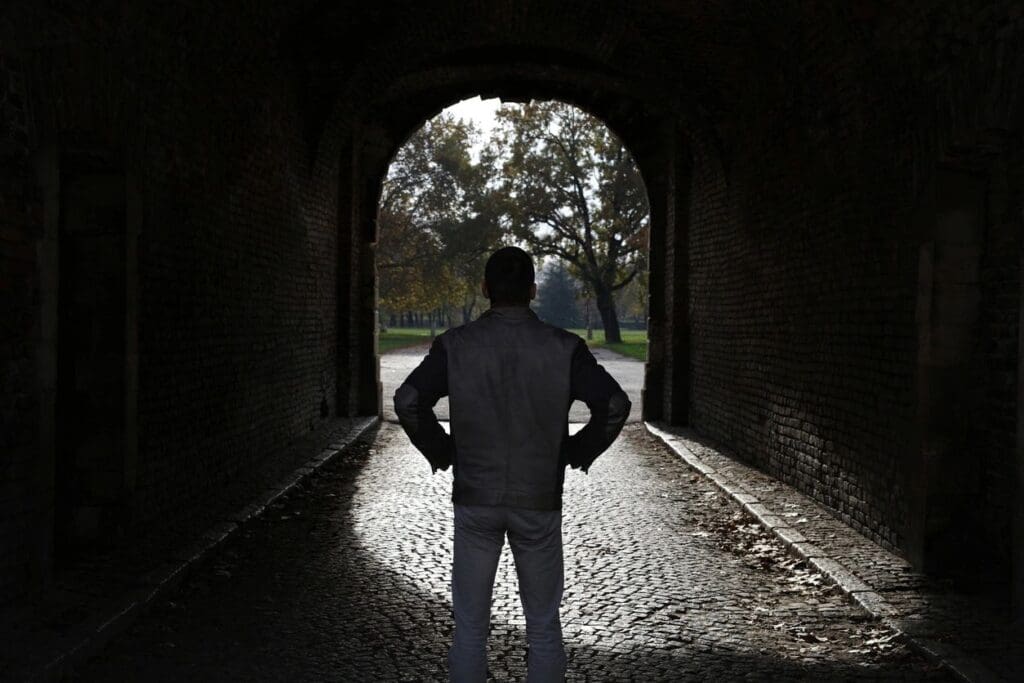
The Tunnel Is Not the Whole Story
Reflections on tunnel vision, hope, presence, trust, alternate paths, and finding light while life is still uncertain.
I recently attended a mindfulness retreat where our discussion centered on a familiar image: the light at the end of the tunnel. A quotation attributed in our retreat materials to Dr. Larry Cammarata gave us our starting point:
“There is indeed light at the end of the tunnel. And the cosmic joke is that you are the tunnel and you are the light.”
We were invited to think about the dark tunnels in our own lives and about what helps us find the light that, perhaps, has been within us all along. As I sat with the metaphor, however, my mind went somewhere slightly different. I began thinking about tunnel vision.
When we are frightened, worried, grieving, overwhelmed, or trapped in a difficult situation, the tunnel can gradually become our entire field of vision. We see the darkness. We search for the distant light. We wonder how much farther we have to go and what additional obstacles might be waiting between where we are and where we hope to emerge.
Without realizing it, we can begin living as though the tunnel is the whole world. But it isn’t. The tunnel is not all that I am. It is not all that my life contains. And perhaps the first glimpse of light comes not from reaching the end, but from remembering that.
When the Tunnel Becomes the Whole World
“Tunnel vision” is more than a convenient metaphor. Under stress and threat, attention really can narrow.
Research on anxiety and attention shows that threatening information can capture a disproportionate share of our attention. Experimental work also suggests that under threat, people may process fewer peripheral cues—sometimes an advantage if irrelevant information is distracting, but a disadvantage when broader information would help us understand the situation more accurately. Researchers studying stress and performance similarly describe disruptions in attentional control when people experience situations as threatening.
That makes good evolutionary sense. If something dangerous is moving toward me, I probably do not need to pause and admire the wildflowers. But psychological threats are rarely that simple.
A prolonged conflict, an uncertain diagnosis, financial difficulty, legal battles, caregiving, grief, loneliness, a troubled relationship, or fear about the future may last for months or years. The attentional system that helps us focus intensely during immediate danger can become exhausting when the perceived danger has no clear endpoint.
The problem itself may occupy only one part of our life, yet our attention allows it to occupy nearly all of our consciousness. That is when the tunnel becomes the whole story.
- We wake up thinking about it.
- We carry it into conversations that have nothing to do with it.
- We imagine future complications that have not happened.
- We replay things that have already happened and cannot be changed.
- We search constantly for the distant opening where everything will finally be resolved.
The mind begins living at the end of the tunnel rather than in the few feet of ground directly beneath us.
Widening the View
One of the things mindfulness offers is not necessarily an escape from the tunnel, but a wider awareness of what is present while we are in it.
Mindfulness is commonly described in psychological research as present-moment awareness accompanied by an attitude of acceptance or nonjudgment. Research suggests that mindfulness-based strategies can improve aspects of emotion regulation, although effects vary across people and practices and should not be exaggerated. A recent meta-analysis involving more than 8,000 participants found small overall emotion-regulation benefits from mindfulness-based strategies, with acceptance or equanimity appearing particularly useful. Earlier reviews similarly suggest that mindfulness practices can produce modest reductions in psychological distress.
What interests me most is not whether mindfulness makes unpleasant feelings disappear. Usually it does not. It changes where we stand in relation to them.
Instead of:
This is terrible. How long until I get out?
We may be able to notice:
This is difficult. It does not define me. This is what is happening in this moment.
That is a subtle shift, but an important one. The imagined future may contain a hundred obstacles. The present moment usually contains far fewer. Perhaps today I need to…
- Make one telephone call.
- Read one document.
- Go to one appointment.
- Ask one question.
- Take one walk.
- Prepare one meal.
- Or perhaps what I need to do in this particular moment is nothing at all.
The entire tunnel does not have to be traveled today.
Tunnels Have More Than One Direction
Another thought occurred to me during the retreat. A tunnel has two ends. We naturally assume that the light we should pursue is the one ahead of us. Forward symbolizes progress. Backward sounds like failure. But what if the entrance behind us is much closer—and much brighter?
There are times when stepping back is not regression. It is perspective. We may need to return temporarily to something that was working.
- Reconsider a decision.
- Rest.
- Seek more information.
- Withdraw from an unproductive conflict.
- Ask whether the destination we were pursuing still makes sense.
- Or simply move back far enough psychologically to see the situation differently.
Research on cognitive reappraisal offers an interesting parallel. A recent meta-analysis involving almost 30,000 participants found a substantial association between greater use of cognitive reappraisal—changing how we interpret a situation—and resilience. That does not mean every problem can be thought away. It suggests that our ability to reconsider how we understand an experience is itself an adaptive resource.
Wisdom asks, “Is this still the right direction?”
They are not always the same thing.
The Side Passages We Forget to Notice
My imaginary tunnel also developed side passages. Real tunnels sometimes have service corridors, alcoves, emergency exits, cross-passages, or places where travelers can move temporarily out of the main route. Life does too. When one problem dominates our attention, we can forget about the parts of life that are not currently in crisis.
- There may still be music.
- A dog who wants to play.
- A garden.
- A friend.
- A book.
- A meal worth enjoying.
- Work that still matters.
- A creative project.
- Prayer.
- A sunset.
- A completely unrelated problem that, for once, is actually easy to solve.
None of these removes the tunnel. That matters.
Sometimes well-intentioned encouragement becomes another demand: Look on the bright side. That is not what I mean. The darkness may be real. But darkness in one part of life does not require us to extinguish every other light.
A side passage can simply be a respite. It gives the mind somewhere else to stand long enough to remember that the tunnel is part of life rather than life itself.
Psychology describes a related quality as psychological flexibility: the capacity to remain in contact with difficult thoughts and emotions without allowing them to rigidly determine everything we do. A 2024 meta-analysis of 67 ACT studies involving more than 9,000 participants found that increases in several aspects of psychological flexibility were associated with reductions in distress.
Psychological flexibility does not mean pretending the tunnel is pleasant. It means retaining the ability to turn our head.
Hope Is More Than Waiting for the Light
The light-at-the-end-of-the-tunnel metaphor can also make hope sound passive. We wait. We keep walking. Someday the light becomes larger. But psychological research on hope offers a more active interpretation.
C. R. Snyder’s influential hope theory describes hope as involving two related capacities: agency, the sense that we can continue moving toward something that matters, and pathways, the ability to identify possible routes toward it.
That changes the tunnel metaphor substantially. Hope is not simply:
It is also:
That side passage I almost ignored may matter. The door I assumed was locked may deserve another look. Someone else may know a route I cannot see. The destination itself may be negotiable.
A recent meta-analysis found that greater hope is associated with lower anxiety across a large body of research, although hope and anxiety influence one another in complicated ways and association is not proof that hope alone causes anxiety to decrease.
Still, the pathways idea is useful. When we feel trapped, perhaps the question is not only:
It may be:
Trusting the Person in the Tunnel
The retreat discussion also led me to think about trust. Not certainty. Trust.
Certainty says:
I know what is going to happen.
Trust says:
I don’t know what is going to happen, but I trust myself to have some capacity to meet it.
Psychology has a word for part of this: self-efficacy—our belief that we can carry out actions necessary to deal with particular situations. That belief does not have to mean, I can solve everything myself.
It may mean:
- I can ask for help.
- I can learn what I need to learn.
- I can tolerate uncertainty.
- I can change direction.
- I have encountered difficult things before.
- I can take the next step even though I cannot yet see the whole route.
Research has repeatedly linked coping-related self-efficacy with better adaptation under stress, although its protective value depends partly on context and on the coping strategies available to us.
One useful practice in a tunnel, then, may be remembering our own evidence. Not abstract affirmations. Evidence.
- What have I survived before?
- What have I learned?
- What resources did I discover only because I needed them?
- When did I believe I could not manage something and then somehow manage it anyway?
- Who helped me?
- What strength did I not know I possessed until circumstances required it?
Trust does not require believing that the tunnel will be easy. It asks whether I am willing to trust the traveler.
Trusting Something Larger Than Ourselves
For many people, trust extends beyond the self. Faith traditions have long addressed what psychology now calls uncertainty, acceptance, resilience, and meaning, although they use different language and begin from different assumptions.
Buddhist traditions remind us of impermanence: conditions arise, change, and pass. Suffering becomes greater when we cling rigidly to the demand that reality must be different from what it presently is. Mindfulness invites us to encounter what is here without immediately judging, resisting, or turning the present difficulty into a permanent identity.
Stoic philosophy asks us to distinguish between what lies within our influence and what does not. We can choose our conduct, our attention, our preparation, and often our response. We cannot command every outcome. The wisdom is not in becoming passive but in investing energy where action is actually possible.
Christian traditions bring another form of trust: the conviction that we need not possess all the strength ourselves. The familiar image from the Twenty-third Psalm is not a promise that we will never enter the valley. It is an assurance that we do not walk through it alone.
Unity and other spiritual traditions emphasize the divine presence within us—the possibility that what we experience as light is not merely a distant destination but something we carry into the darkness.
Different people understand that source differently.
- God.
- Spirit.
- Love.
- Universal consciousness.
- Nature.
- The accumulated wisdom of humanity.
- Something beyond language.
The particular theology matters deeply to the person who holds it, but the practical question may be shared:
Faith does not necessarily illuminate the entire tunnel. Sometimes it provides enough light for one more step.
We Do Not Have to Walk Alone
There is another problem with the traditional tunnel image. It usually contains one person. That is probably inaccurate.
Human beings are profoundly social creatures, and social support can change how we experience stress. Reviews of physiological and psychological research suggest that supportive relationships can sometimes reduce stress reactivity, although the benefit depends greatly on the nature of the relationship and the kind of support being offered.
- Sometimes another person brings information.
- Sometimes they bring resources.
- Sometimes they help us identify a side passage.
- Sometimes they simply sit with us in the dark.
That last contribution is easy to underestimate. There are moments when the most helpful thing another person can say is not:
“Here is how you get out.”
It is:
“I’ll stay with you while you find your way.”
We do not necessarily need someone to carry us through the tunnel. Sometimes we need companionship long enough to remember that we can still walk. And if one trusted person is not available, perhaps we can distribute that support: a friend for perspective, a professional for expertise, a spiritual community for meaning, a colleague for practical advice, a neighbor for companionship, or someone who simply makes us laugh.
There is no rule requiring us to navigate difficulty alone in order for our strength to count.
Some Practices for Tunnel Moments
The tunnel metaphor suggests several simple practices I want to remember when my own vision begins narrowing.
Widen the aperture. Ask, What else is true right now? The problem may be real, but what else exists alongside it? Look around literally. Notice the room. Notice your breathing. Notice something beautiful, ordinary, amusing, or alive. The goal is not distraction. It is restoration of proportion.
Look for side passages. Ask, What are three other things I could do? One may be to continue forward. Another may be to wait. Another may be to ask for help. Another may be to change the goal. Hope grows when we can imagine pathways rather than only outcomes.
Check both ends. Ask, Must progress mean moving forward? Sometimes a strategic retreat, pause, or reconsideration is the wisest movement available.
Shrink the tunnel. Instead of asking, How will I get through all of this? ask, What does this moment require? Then perhaps, What does today require? Present-moment attention prevents tomorrow’s imagined difficulties from joining today’s actual ones.
Review the evidence of your own life. Ask, What have I already survived, learned, endured, or adapted to? Trust is easier when it is grounded in memory rather than wishful thinking.
Borrow light. Call someone. Ask a question. Seek expertise. Pray with someone. Sit beside someone. Let another person’s perspective temporarily widen your own.
Release what is not yours to control. This may be the hardest practice. Identify what belongs to you—your choices, preparation, integrity, attention, response—and what does not. Then practice returning your energy to the first category.
Allow respite without guilt. You are permitted to leave the tunnel psychologically for an hour. Read. Walk. Cook. Play. Create. Laugh. Rest. The problem will still be available when you return to it. Constant vigilance is not the same thing as effective coping.
Perhaps the Light Is Already Here
I still like the traditional idea of light at the end of the tunnel. Hope matters. There are times when we truly do need to keep walking toward something we cannot yet reach.
But I no longer want to make the distant light responsible for all of my wellbeing.
- There may be light behind me.
- There may be openings along the side.
- Someone beside me may be carrying a lantern.
- My eyes may gradually adjust to the darkness.
- And perhaps I am carrying more light than I realize.
The tunnel itself may teach me something, but it does not deserve to become my entire identity.
- It is a place I am passing through.
- It is one part of the landscape.
- It is one chapter in a much larger story.
When the darkness becomes overwhelming, perhaps I do not need to see the entire route.
- I may only need enough light to see where I am standing.
- Enough trust to take the next step.
- Enough flexibility to choose another path when it presents itself.
- Enough presence to recognize that this moment is survivable.
- Enough humility to accept another person’s hand.
- And enough faith—whether in myself, in others, in God, or in whatever larger source gives my life meaning—to remember that darkness and light have never been mutually exclusive.
Perhaps that was the “cosmic joke” in the quotation that began our retreat discussion.
I kept searching the tunnel for the light.
Then I remembered to look at what I had brought with me.
Explore Further
If this reflection speaks to something in your own life, these companion resources provide opportunities to explore the ideas more deeply. The essay is available above for easy reading on any device; the PDF versions below can be opened or saved if you prefer.
The Tunnel Is Not the Whole Story
Open or save a formatted PDF copy of the complete Considering Life reflection.
Open Essay PDFAnnotated Bibliography & Further Reading
Explore the research on attention, mindfulness, hope, psychological flexibility, cognitive reappraisal, self-efficacy, resilience, and social support that informs the reflection.
Explore the Research7-Day Guided Journal
Use seven days of reflection to explore your own tunnel, widen the landscape, identify alternative paths, strengthen self-trust, and notice where light may already be present.
Open the JournalPractice Companion
Find brief tools for tunnel moments along with more intentional practices for strengthening perspective, presence, flexibility, hope, trust, and connection.
View the Practice CompanionAn Adbrook Literary Publication
© 2026 Adbrook Services LLC, through its publishing imprint, Adbrook Literary. All rights reserved.
This material is made available to the Valor Institute Community with permission of Adbrook Literary for charitable educational and quality-of-life purposes. Copyright ownership remains with Adbrook Services LLC.
Individuals may access, download, and print these materials for their own personal, noncommercial use. Reproduction, redistribution, republication, adaptation, organizational use, instructional use, or commercial use beyond that personal permission requires prior written authorization.